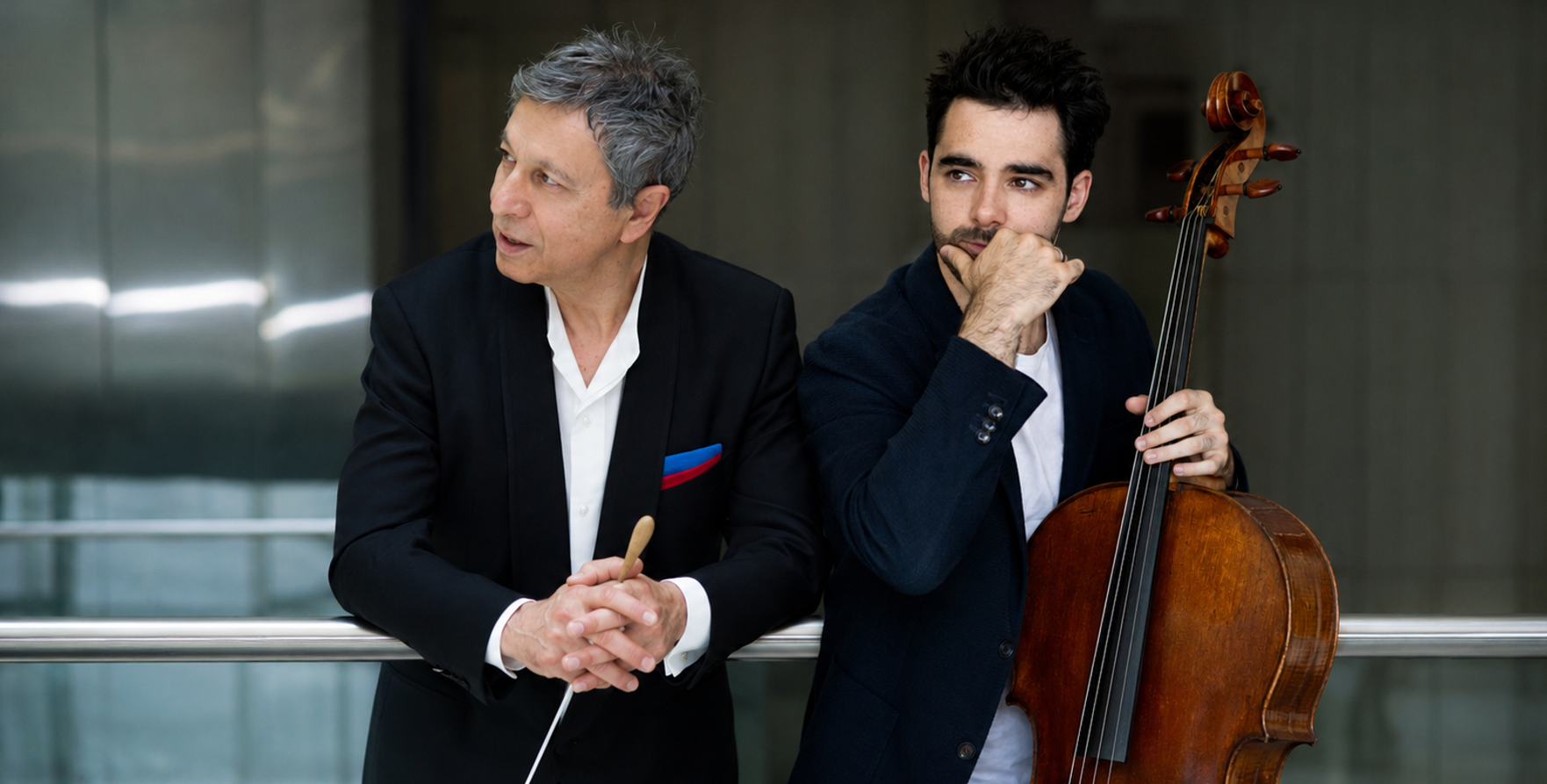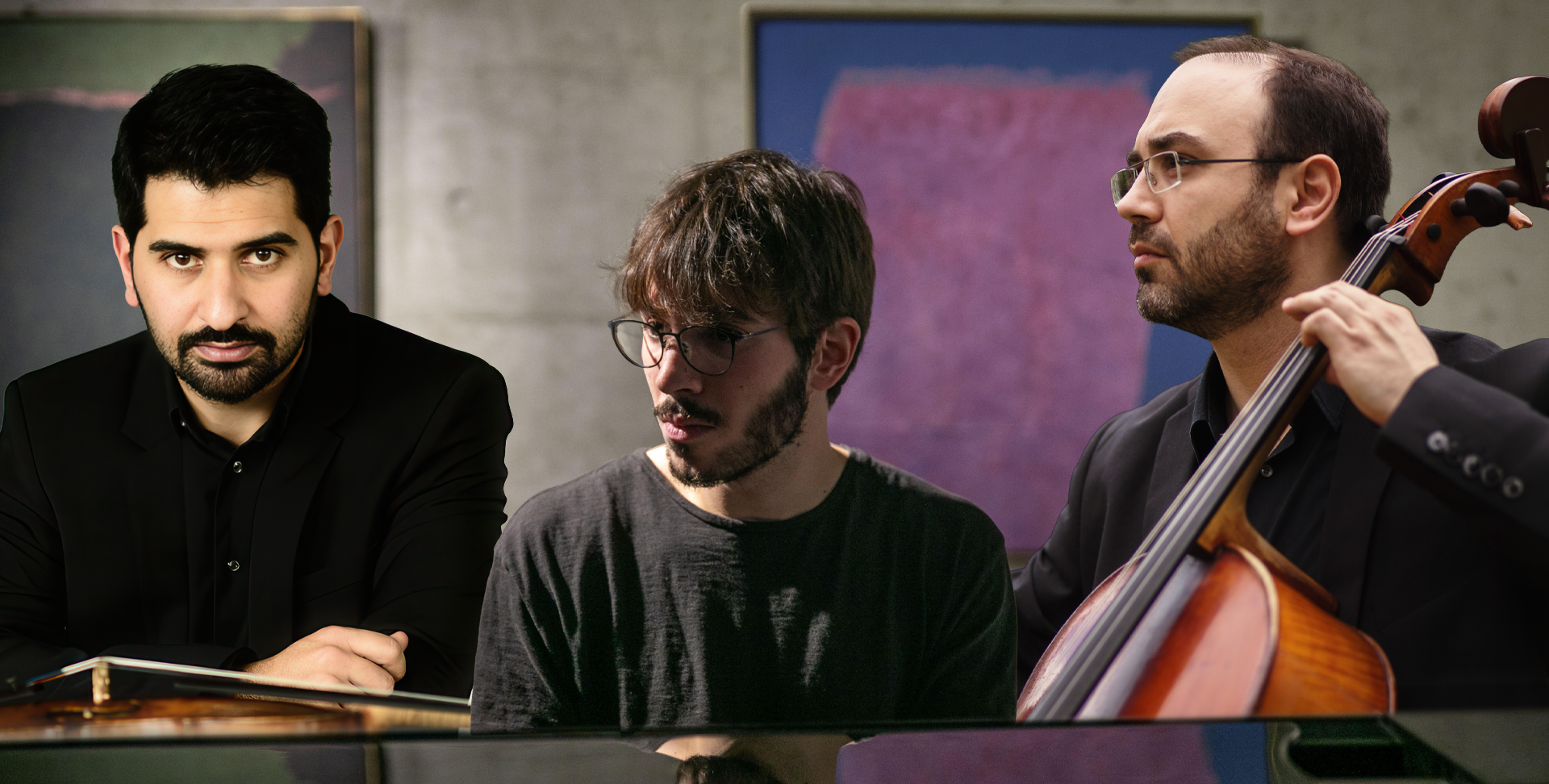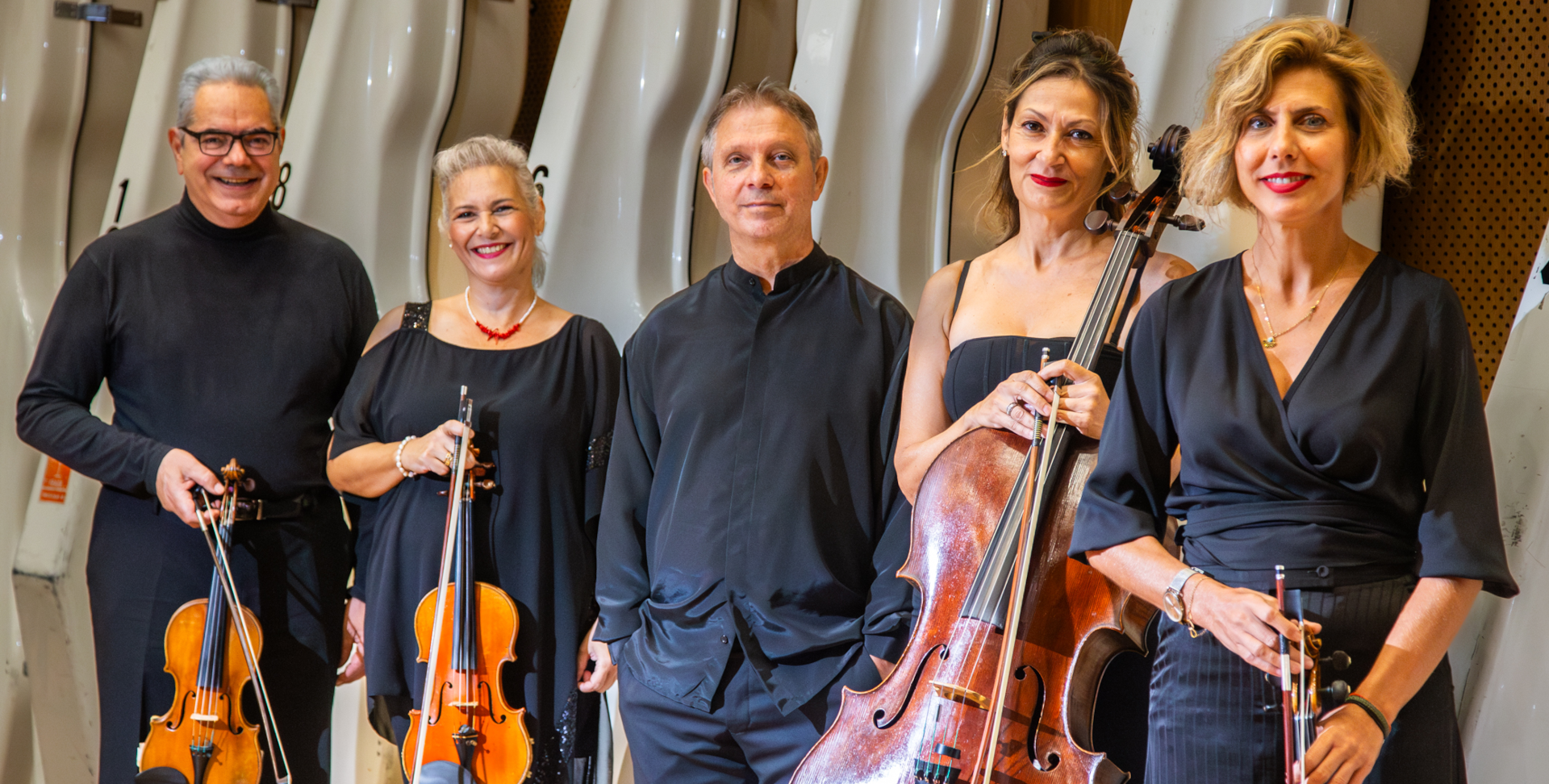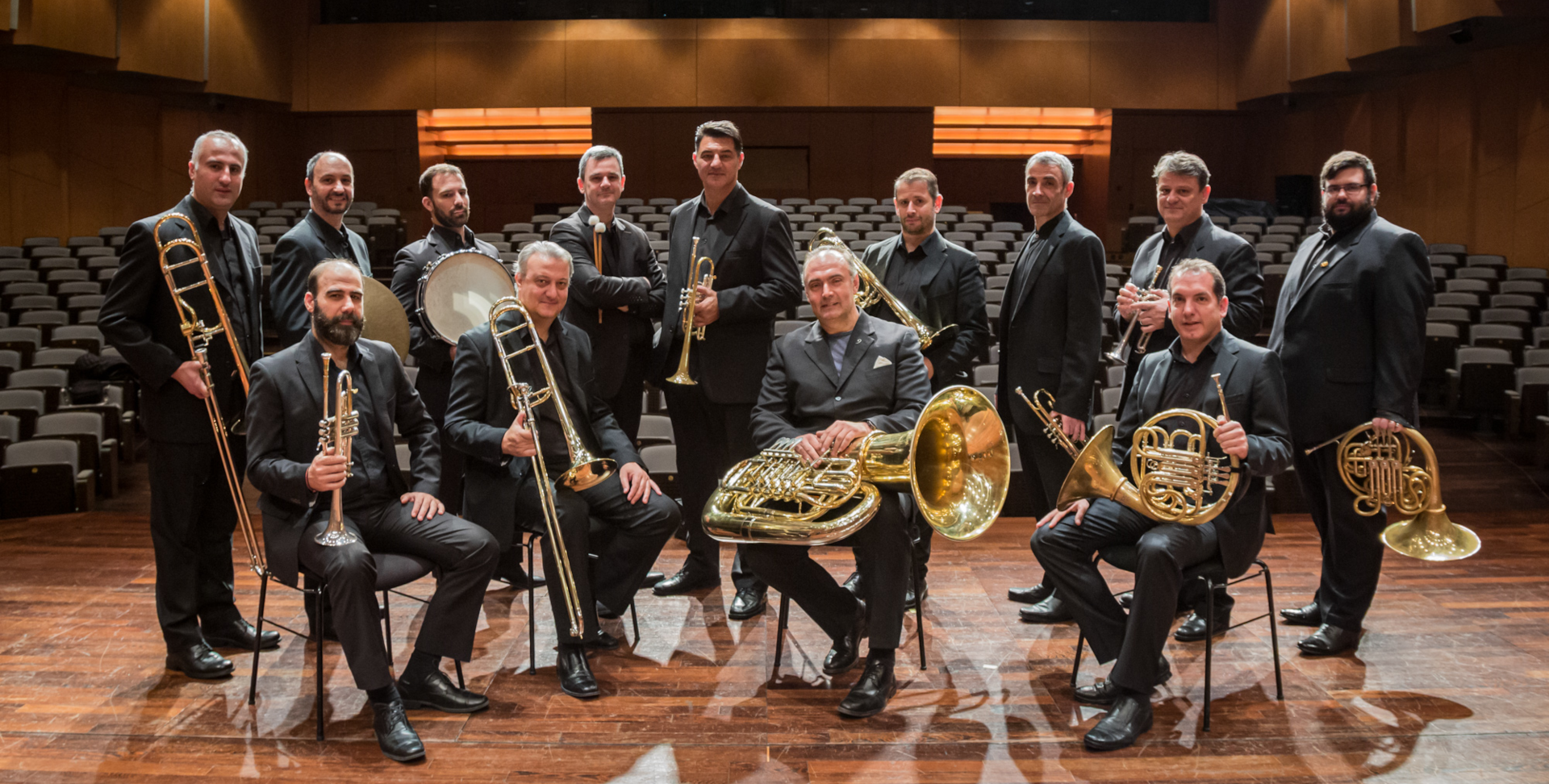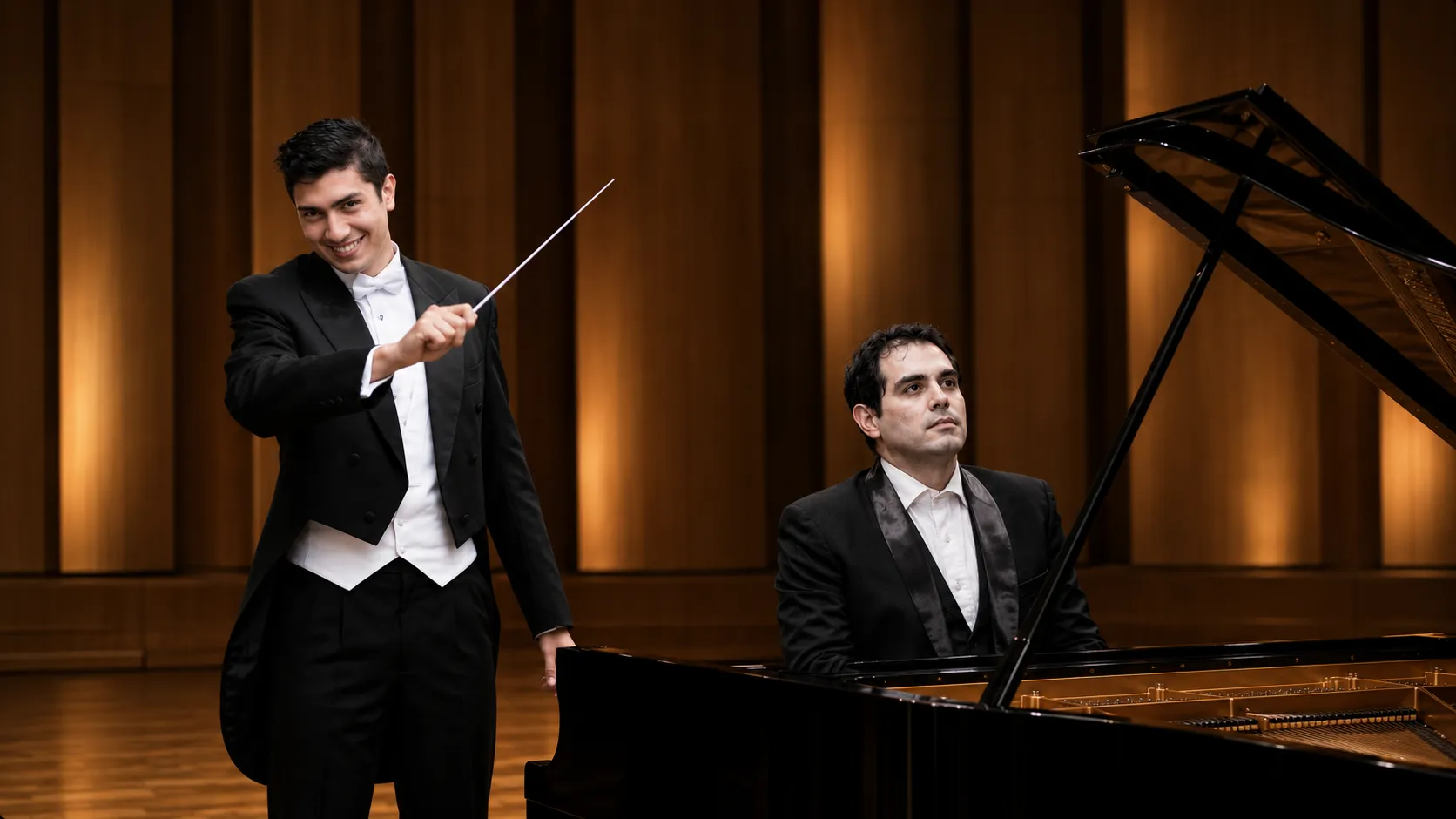
Three Athens State Orchestra musicians pose together inside an elegant concert hall. The conductor stands on the left with a raised baton, the oud soloist is at the centre holding his instrument, and the trumpeter stands on the right holding his trumpet. Warm theatrical lighting and the grand concert hall setting create the impression of a single professionally photographed ensemble.

Late Night with the Athens State Orchestra

Last year’s attempt to have a concert later than the usual featuring a repertoire in a more… “nighttime” mood, was truly successful; so, this year, in response to the requests of our loyal audience, we are attempting something similar. Marcel Khalife’s concert shall assign for the first time in our history the soloist role to the oud, performed by the Greek master, Alekos Vretos. Exotic tone colors also prevail in the Venezuelan trumpeter Pacho Flores’s performance of a work of his own. The concert, conducted by Panagiotis Diamantis, an active figure within and outside the Greek borders, closes with the overwhelming Latin music rhythms of the Argentinean Alberto Jinastera’s Dances.


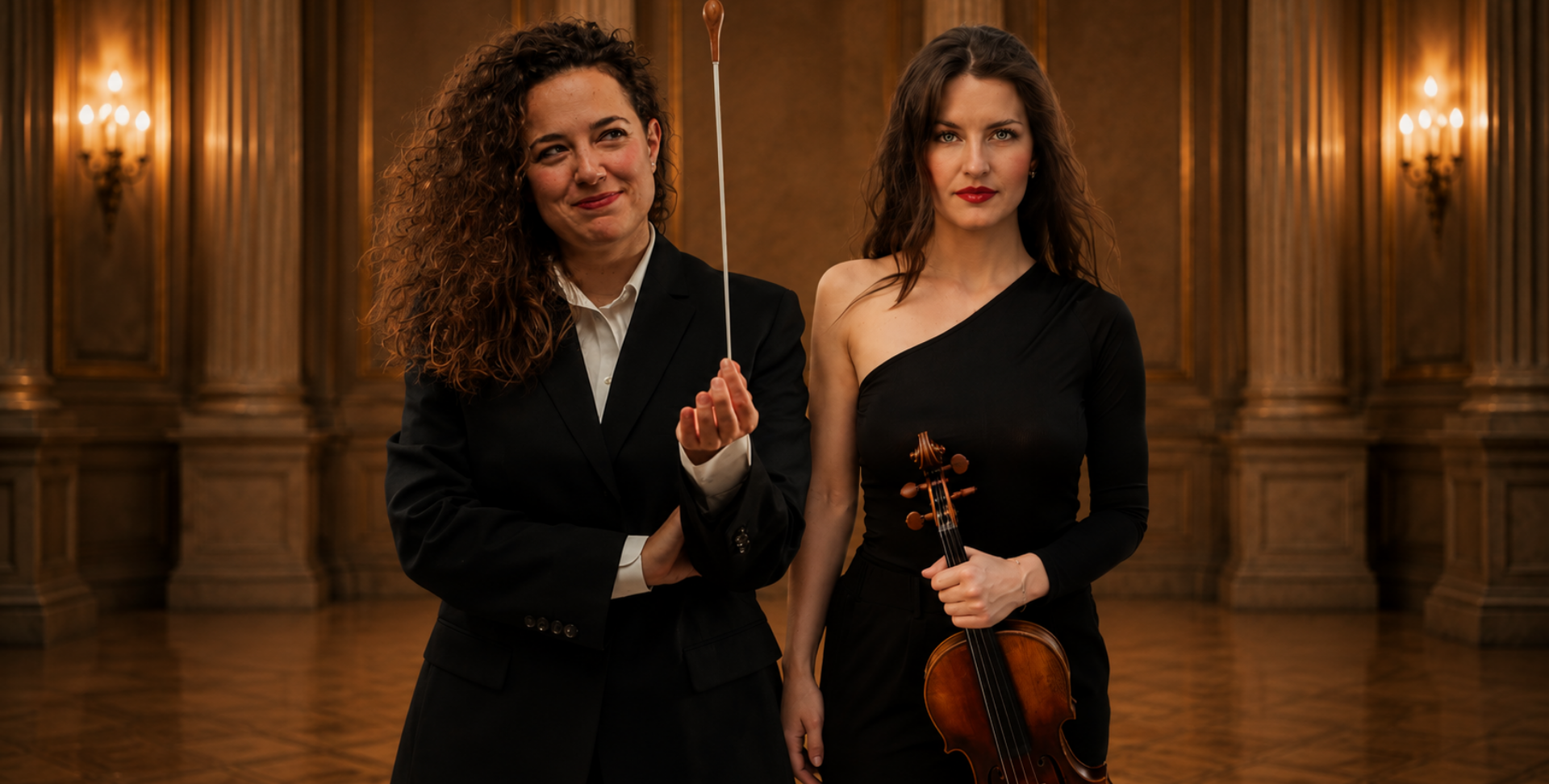
Conductor Loukas Karytinos stands at the center with baton raised, joined by a smiling cellist on the left and a violinist in a red dress on the right. The three musicians are posed together in a warmly lit concert hall with a dark theatrical background.

Concert at Terneuzen Festival, Netherlands

2026-2027 artistic period starts with the glory corresponding to an opening concert in which the Athens State Orchestra, under the baton of its artistic director, Lukas Karytinos, and in collaboration with two internationally renown, young and repeatedly distinguished soloists, presents important symphonic works of the 19th and the 20th century. What all of such works have in common is that their composers chose to align with their times’ avant-garde: Beethoven consciously changed the tide of music history in every single key; young Saint-Saëns followed Liszt's and Wagner’s aesthetic ideals, while Shostakovich expressed the 20th century’s outbreaks and tragedies so vividly as few others did.


Conductor Loukas Karytinos stands at the center with baton raised, joined by a smiling cellist on the left and a violinist in a red dress on the right. The three musicians are posed together in a warmly lit concert hall with a dark theatrical background.

Concert at Concertgebouw, Amsterdam

2026-2027 artistic period starts with the glory corresponding to an opening concert in which the Athens State Orchestra, under the baton of its artistic director, Lukas Karytinos, and in collaboration with two internationally renown, young and repeatedly distinguished soloists, presents important symphonic works of the 19th and the 20th century. What all of such works have in common is that their composers chose to align with their times’ avant-garde: Beethoven consciously changed the tide of music history in every single key; young Saint-Saëns followed Liszt's and Wagner’s aesthetic ideals, while Shostakovich expressed the 20th century’s outbreaks and tragedies so vividly as few others did.


Conductor Loukas Karytinos stands at the center with baton raised, joined by a smiling cellist on the left and a violinist in a red dress on the right. The three musicians are posed together in a warmly lit concert hall with a dark theatrical background.

Lukas Karytinos, Alexandra Conunova and Hannah Jiwon Kim

2026-2027 artistic period starts with the glory corresponding to an opening concert in which the Athens State Orchestra, under the baton of its artistic director, Lukas Karytinos, and in collaboration with two internationally renown, young and repeatedly distinguished soloists, presents important symphonic works of the 19th and the 20th century. What all of such works have in common is that their composers chose to align with their times’ avant-garde: Beethoven consciously changed the tide of music history in every single key; young Saint-Saëns followed Liszt's and Wagner’s aesthetic ideals, while Shostakovich expressed the 20th century’s outbreaks and tragedies so vividly as few others did.


Corinth's concerto, concert in Nafplion

This year's artistic season concludes with another concert tour outside Athens. Leo Brouwer's Corinth Concerto for guitar, commissioned by the Greek Orchestra of Athens and the Municipality of Corinth, is a wonderful musical "prelude" before the performance of the famous Ninth Symphony by the Czech Romantic Antonín Dvořák, conducted by Nikos Haliasas. This famous symphony was written at the end of the 19th century during the composer's stay in New York, drawing on his musical experiences in the United States and incorporating them into an emotionally charged and orchestrationally brilliant symphonic masterpiece.

Under the auspices and with the support


Opera Gala in Chania

Organisation of the Region of Crete in collaboration with the the Ephorate of Antiquities of Chania, the Municipality of Chania and the Athens State Orchestra.

Under the direction of the acclaimed conductor Elias Voudouris , the Orchestra collaborates with two internationally renowned Greek opera artists: soprano Myrto Papathanasiou and baritone Dimitris Platanias . Together, they promise a magical journey into the world of opera, with arias from leading works of the international repertoire, which highlight the passion and virtuosity that make opera a timeless art form.

The concert is one of the most important events of this year's Crete Festival, confirming the constant effort of the Region of Crete to offer to the audience major cultural events and to create bonds between the universal cultural creation and the unique cultural identity of the island of Crete.

Transport sponsor: ANEK Lines


Opera Gala in Heraclion

Organisation of the Region of Crete in collaboration with the Organisation of Culture and Development of Potamia "Gouverniotissa", the Ephorate of Antiquities of Heraclion, the Municipality of Hersonissos and the Athens State Orchestra.

Under the direction of the acclaimed conductor Elias Voudouris , the Orchestra collaborates with two internationally renowned Greek opera artists: soprano Myrto Papathanasiou and baritone Dimitris Platanias . Together, they promise a magical journey into the world of opera, with arias from leading works of the international repertoire, which highlight the passion and virtuosity that make opera a timeless art form.

The concert is one of the most important events of this year's Crete Festival, confirming the constant effort of the Region of Crete to offer to the audience major cultural events and to create bonds between the universal cultural creation and the unique cultural identity of the island of Crete.

Transportation sponsor: ANEK Lines


Opera Gala

Under the direction of the acclaimed conductor Elias Voudouris , the Orchestra collaborates with two internationally renowned Greek opera artists: soprano Myrto Papathanasiou and baritone Dimitris Platanias . Together, they promise a magical journey into the world of opera, with arias from leading works of the international repertoire, which highlight the passion and virtuosity that make opera a timeless art form.


Lyricism and Introspection

The Athens State Orchestra returns to the Benaki Museum, continuing their long-standing collaboration.


Gustav Mahler: Symphony No. 8, “Symphony of a Thousand”

Even within the monumental symphonic output of Gustav Mahler, Symphony No. 8 occupies a singular place. It signals an extreme –indeed, a culmination – not only in the Mahlerian oeuvre, but in the Romantic symphonic lineage in its entirety. The epithet “Symphony of a Thousand” was not the composer’s own, but was coined by the impresario Emil Gutmann as a publicity device ahead of the premiere. It may sound like an exaggeration today, yet it is estimated that no fewer than 858 singers and 171 musicians participated in the performance. And yet, the essence of the work lies neither in its duration (Symphony No. 3 is longer) nor in the sheer scale of its performing forces (Symphony No. 2 demands similarly vast resources). The undisputed grandeur of the “Eighth” resides in its purely affirmative spirit: it is the only one of Mahler’s symphonies entirely devoid of irony, doubt, or inner conflict. Instead, it unfolds with a masterful, unyielding rhetorical force, conveying messages of profound spirituality with unflappable inner conviction and musical certainty. Its premiere on 12 September 1910 in Munich, conducted by the composer himself, was the greatest triumph of Mahler’s lifetime, just seven months before his death. Mahler himself regarded the Eighth as his supreme compositional achievement, while the great German writer Thomas Mann encapsulated the essence of this colossal work when he wrote that it “expresses the art of our time in its profoundest and most sacred form.”
Surely, practical considerations alone render performances of the Eighth a rare artistic event – and therefore one of exceptional significance. On this occasion, the internationally acclaimed Polish conductor Michał Nesterowicz leads the Athens State Orchestra, joined by an outstanding roster of vocal soloists and extensive choral forces, offering the Festival audience one of those rare opportunities to experience this epic masterwork live.