
Liszt's Christmas oratorio
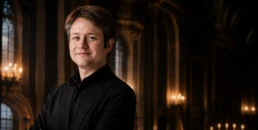
Christmas is not exclusively connected to Santa Claus’s figure, Christmas trees, presents and family reunions; first and foremost, Christmas marks the arrival of a message of Hope, the celebration of a Birth that transcends human measure and promising something larger, beyond the narrow human view. Liszt and Kodály, two important Hungarian composers of the 19th and the 20th century correspondingly, have expressed through their music Man’s awe before God’s incarnation, in the most ideal and passionate way. The Athens State Orchestra, selected lyrical artists and active choruses, under the baton of the versatile conductor Michalis Zeke, give this Christmas the corresponding spiritual dimension through great religious music pieces, worthy of being remembered or discovered by all of us.

Stravinsky's Petrushka
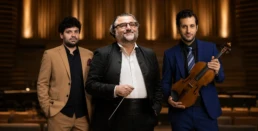
Talented and renown musicians, such as Iason Keramidis, violinist, Ilias Livieratos, violist and Georgios Balatsinos, conductor, make us proud and once again prove that Greek artists may perform in an equally fascinating way as their best peers from abroad! Let’s verify it, by listening to the two soloists creating a fine musical narrative in Mozart’s Sinfonia Concertante, and the third conducting the Athens State Orchestra, extracting the vitality and transcending energy required by the famous Stravinsky’s ballet, “Petrushka”.
Beethoven's Eroica
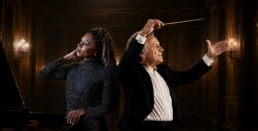
It’s with great pleasure and emotion that the Athens State Orchestra welcomes again, after several years, the tireless conductor and composer, Yoav Talmi, a true “Master” of music, setting his long experience in Beethoven’s work at the service of the piece that inaugurated a new era for the composer and for music all over the world: Eroica Symphony! By his side, the young British pianist, Isata Kanneh-Mason, one of the most demanded piano soloists globally, originating from a prominent music family, performs the last and clean-cut beautiful Mozart’s piano concert.

Brahms - Lugansky
Russian conductor, Stanislav Kochanovsky and his compatriot, the pianist Nikolay Lugansky, do not merely enjoy successful international careers; their names have come to be synonymous with the pinnacle of poeticism, subtlety, and sensitivity. Both the former’s performance of Johannes Brahms’s final and, in every respect, most mature Symphony, as well as the two artists’ collaboration on the German Romantic composer’s colossal Concerto no.2, are expected to be spellbinding and worthy of the depth of these two iconic symphonic works of German Romanticism.
Liszt with Alexei Volodin
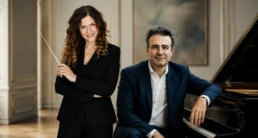
The Athens State Orchestra performs under the reputable musical direction of the experienced conductor Zoi Tsokanou and featuring the distinguished Russian soloist Alexei Volodin, who has repeatedly captivated Athenian audiences in recent years with his dazzling performances. Both Nikos Astrinidis’s fascinating work -inspired by a short story by Edgar Allan Poe- and the romantic music of Franz Liszt and Albert Russell, with their high emotional intensity and orchetral brilliance, promise an unforgettable listening experience.
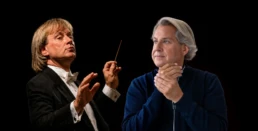
Alain Lefevre plays Gershwin
Carl St. Clair’s name is directly linked to the Pacific Symphony Orchestra by being its artistic director for 35 years; a lasting, creative task rendering him the longest-serving American-born conductor of a major U.S. orchestra. Deeply versed in the American symphonic repertoire, as well as one of its most inspired performers, he has left his mark on beloved melodies combining symphonic glory with Broadway’s pieces’ levity and sensuality. Carl St. Clair performs together with Alain Lefèvre, the famous French-Canadian pianist, well-known to the Athenian audience for his “electrified” playing attitude.
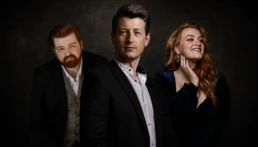
Gustav Mahler - The Song of the Earth
For many people, the Song of the Earth is Mahler’s most complete and moving symphony, composed during a hard period of his life; a dramatic work, a deeply human quest for relief and metaphysical consolation, harmonically combining conceptual broadness of a symphony with the clean-cut charm of ancient Chinese poetry and the penetrating boldness of human voice. An ascending figure, British conductor Duncan Ward stands at the helm of this performance, together with two lyrical artists already starring at the world’s greatest theaters
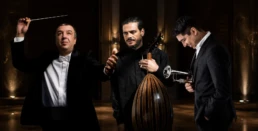
Late Night with the Athens State Orchestra
Last year’s attempt to have a concert later than the usual featuring a repertoire in a more… “nighttime” mood, was truly successful; so, this year, in response to the requests of our loyal audience, we are attempting something similar. Marcel Khalife’s concert shall assign for the first time in our history the soloist role to the oud, performed by the Greek master, Alekos Vretos. Exotic tone colors also prevail in the Venezuelan trumpeter Pacho Flores’s performance of a work of his own. The concert, conducted by Panagiotis Diamantis, an active figure within and outside the Greek borders, closes with the overwhelming Latin music rhythms of the Argentinean Alberto Jinastera’s Dances.
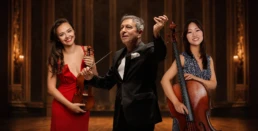
Concert at Terneuzen Festival, Netherlands
2026-2027 artistic period starts with the glory corresponding to an opening concert in which the Athens State Orchestra, under the baton of its artistic director, Lukas Karytinos, and in collaboration with two internationally renown, young and repeatedly distinguished soloists, presents important symphonic works of the 19th and the 20th century. What all of such works have in common is that their composers chose to align with their times’ avant-garde: Beethoven consciously changed the tide of music history in every single key; young Saint-Saëns followed Liszt's and Wagner’s aesthetic ideals, while Shostakovich expressed the 20th century’s outbreaks and tragedies so vividly as few others did.
Concert at Concertgebouw, Amsterdam
2026-2027 artistic period starts with the glory corresponding to an opening concert in which the Athens State Orchestra, under the baton of its artistic director, Lukas Karytinos, and in collaboration with two internationally renown, young and repeatedly distinguished soloists, presents important symphonic works of the 19th and the 20th century. What all of such works have in common is that their composers chose to align with their times’ avant-garde: Beethoven consciously changed the tide of music history in every single key; young Saint-Saëns followed Liszt's and Wagner’s aesthetic ideals, while Shostakovich expressed the 20th century’s outbreaks and tragedies so vividly as few others did.